
Article by Carlotta Profico
Translated by Giorgia Cattaneo
After decades in the industry, a renowned music producer fights to preserve his record label, Stackin’ Hits Records, as it faces a looming takeover by a global corporation. His efforts are suddenly disrupted when, from his penthouse overlooking the Brooklyn Bridge, he learns that his teenage son has been kidnapped.
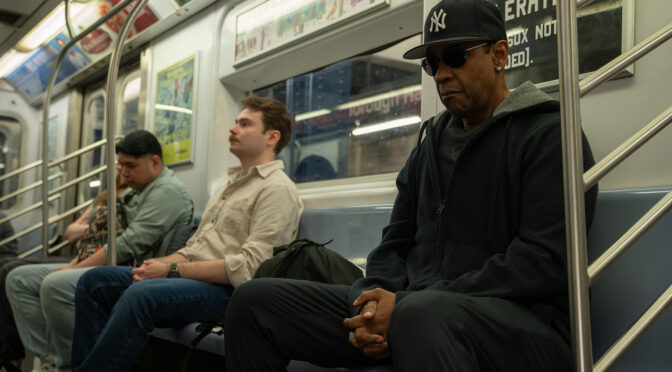
The film opens with David King, a famous, uncompromising music mogul played by Denzel Washington, who is prepared to mortgage his penthouse and relinquish the luxury that defines his life in a final attempt to save his record label. Shortly after the abduction, his son Trey is released; however, due to a case of mistaken identity, the kidnapper ends up detaining the son of King’s driver and closest friend. King is thus confronted with an impossible choice: pay the ransom or safeguard his recording empire.
Twenty years after Inside Man, Spike Lee returns to the world of music, placing hip-hop at the center of the narrative and using it as the connective thread that ultimately reveals the kidnapper’s identity. Highest 2 Lowest faithfully captures the stylistic hallmarks of hip-hop culture: its tension between emerging performers and established rappers, between impoverished neighborhoods and gleaming luxury high-rises. Within this duality, clothing becomes a crucial visual marker of identity. At the highest end stands David King in his pinstripe suits; at the lowest, we find Young Felon, a small-time criminal in Jordans and a New Era cap. This contrast is heightened by the artificial sheen of opulent interiors, the gritty realism of street-level cinematography and a tight, rhythmic editing style punctuated by tracks from James Brown, A$AP Rocky, and Aiyana Lee.
It’s a tight, engaging thriller where Spike Lee digs into how hard it is to be an artist today, in an industry where attention is scarce and music too often becomes an afterthought.