
Article by Dina Aghaei
Translated by Giorgia Cattaneo
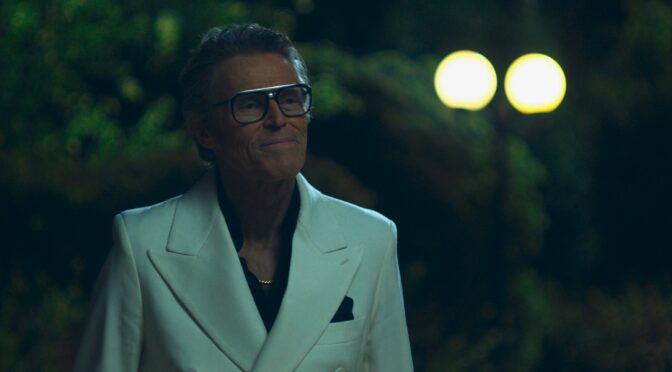
To mark his daughter Sofia’s twenty-fifth birthday (Vic Carmen Sonne) –now his sole heir after the death of his son– Marcos Timoleon (Willem Dafoe), a wealthy Greek shipowner, hosts an elaborate celebration on his private island. A party that seems to be choreographed down to the last detail. But things don’t unfold quite according to his script.
Premiering at the Locarno Film Festival and adapted from Panos Karnezis’s novel with the same name, The Birthday Party by Miguel Ángel Jiménez condenses its narrative almost entirely into a single day: Sofia’s birthday.
As master of the island, Marcos brings together a circle of influential guests and acquaintances who, much like him, approach the event as if it were a strategic game of chess. In this game, family bonds, affection, and intimacy are readily sacrificed in pursuit of wealth and power. The atmosphere may be luxurious and refined, but beneath its surface lies a world that feels unsettling and corrupted.
Stylistically, The Birthday Party draws on a 1970s-inspired aesthetic through its cinematography and production design, but despite the fact that the cast delivers strong performances, the screenplay feels less assured. Relationships and character dynamics often ring hollow, and Marcos never fully gains the dramatic weight that the story demands of him. This may be due to the shift from Karnezis’s novel –building a rich biographical portrait of Timoleon through continuous flashbacks– to a film that confines its conflict to the present moment of the party and its aftermath and sacrifices part of the character’s psychological complexity.
Much of the film’s meaning is entrusted to its symbolic language, which Jiménez uses to explore family power dynamics and the shadows that loom over them. Central among these symbols is the reproduction of one of the tapestries from the series The Lady and the Unicorn. It appears repeatedly, embodying the film’s core themes: restrained desire and the role imposed on the daughter. This becomes explicit in the scene where the fake horn of the unicorn which is given to Sofia by Marcos breaks off: this symbolic gesture exposes the deception beneath the surface and reveals a father’s authority which begins fracturing.