
Article by Marta Mastrocinque
Translation by Maria Julia Amicizia
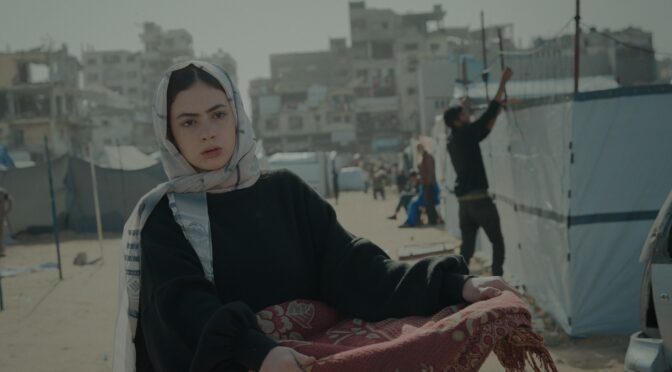
Shot entirely in the Gaza Strip in the Al-Awda refugee camp, Thirteen in Gaza marks Palestinian director Hosam Abu Dan’s fiction feature debut. Screened at the 44th Torino Film Festival, the film follows a thirteen-year-old girl and her father after the loss of their home and most of their family due to a bombing.
The main character Raghad (Mary Ziyara) lives in a tent with her father, Abu Raghad (Firas Al-Masri). At the age of thirteen, she has to go through the changes in her body, first and foremost her first period, while being in an environment where privacy and essential services are nowhere to be found. Even the simplest tasks become an ordeal: queuing for the toilet, washing up, getting hold of clothes and basic necessities. The war is a constant presence, it’s in the sound of drones and explosions, but the director chooses to narrate it through everyday life rather than dwelling on images of destruction.
At the heart of the story there is the bond between father and daughter. Abu Raghad tries to protect Raghad, but struggles to understand the needs of a girl on the threshold of adolescence. The plot thickens when he gets in contact with Khalil (Ghassan Salem), a trader who amasses wealth by stealing and reselling humanitarian aid. Using his wealth as leverage, Khalil goes so far as to propose marrying Raghad, leaving her father with a difficult choice.
Thirteen in Gaza does not idealise its characters, it shows how greed, inequality and cultural pressure persist even in the most extreme conditions. The performances are convincing: Mary Ziyara captures her character’s uncertainties with great naturalness, while Firas Al-Masri portrays a father torn between affection, despair and the need to survive.

The cinematography favours close-ups, silences and details of the surroundings, while the endless noise of aircrafts keeps the war in the background of every scene. Shot in just twelve days with a local crew, this film is the first fiction feature to be made entirely in Gaza in the last twelve years.
The film’s strength lies in its ability to portray Gaza through its people, their relationships and their daily conflicts, without reducing its protagonists to their status as victims. Intimate and restrained, the story gives complexity and dignity to a reality often seen only through images of war.