
Article by Marta Mastrocinque
Translation by Maria Pasquetto
There’s no need for destroyed cities, explosions or fleeing crowds to depict the end of the world. Los Nadadores is the directorial debut of Argentine filmmaker Sol Iglesias SK, and it portrays four friends seeking relief in abandoned swimming pools during a seemingly never-ending summer. Presented in the Feature Films Competition of the 44th Torino Film Festival, the film imagines a near future where the heat has reached unbearable levels and urban life has been compromised.
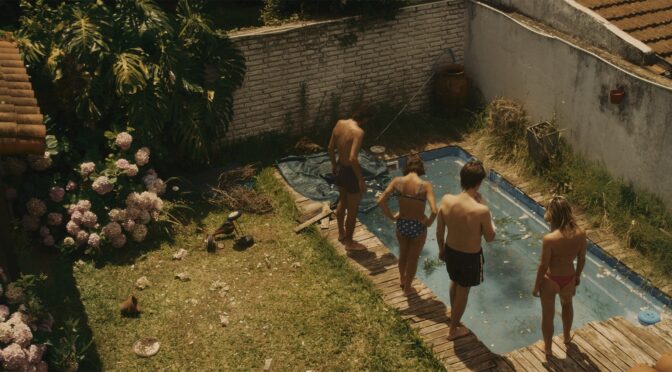
It’s the 368th day of an endless summer. Temperatures are 50°C, there are constant power outages, the sun doesn’t set and most of the population has left the city. Wandering the empty streets we meet Victoria (Valentina D’Emilio), Maqueta (Tobías Reizes), El Rubio (Joaquín Fretes) and Ella (played by the director herself). Their way of dealing with the situation is quite simple: breaking into abandoned houses to use the pools to find relief from the heat. A practice that gradually becomes a form of survival.
Iglesias chooses a non-traditional narrative without a central conflict or a familiar dramatic arc. The protagonists wander, drink, smoke, explore houses and dive into the water. The repetition of these actions conveys the monotony of a hanging life where curiosity, boredom and concern coexist. Climate change is not explained with words but remains in the background as a reality which is impossible to ignore.
This choice is reinforced by Sofía Lizzoli’s cinematography, which transforms the constant light into an almost hallucinatory presence, and by the soundscape, which emphasizes the sense of isolation and disorientation. Lucrecia Martel’s filmography has an undeniable impact on the story – specifically La ciénaga (2001) – and influences from Argentine fantasy cinema.

Some scenes suffer from a sense of vagueness and the absence of a narrative structure might challenge those viewers in search of more commonly structured stories. And yet, Los Nadadores finds its own identity in transforming environmental collapse into an everyday experience, without resorting to an apocalyptic show. The protagonists are no heroes and they don’t seek solutions. They simply keep moving from one swimming pool to another, whilst the world changes irreversibly. A minimalist and unsettling dystopia that depicts the future through the apathy of a generation with no prospects.