
Article by: Ludovico Franco
Translated by: Alessandra Di Paola Seminara
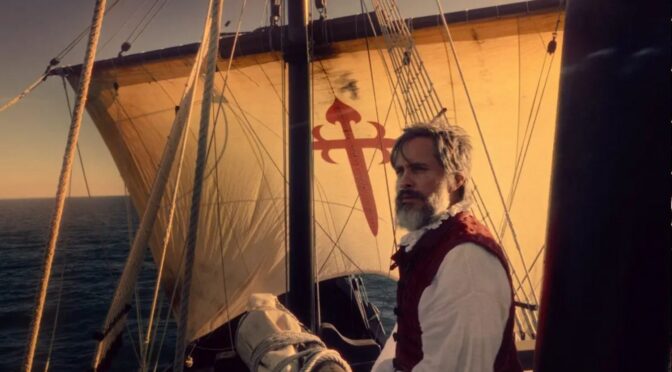
Just like Magellan (Gael García Bernal), who keeps veering off course as he crosses the oceans, Lav Diaz probes new stylistic perspectives for his cinema: with Albert Serra as producer, Diaz shoots for the first time in a language other than Tagalog and adopts color. He brings the violence of colonialism back to its archaic roots, reinterpreting the figure of the explorer and the myth of the Age of “Discoveries.”
To understand the current situation of his country, the Philippines, he shifts the chronological focus to the moment when Europeans began to insinuate themselves virulently into the archipelago between 1511 and 1521, the year of Magellan’s death. While the adventurer roams the oceans to circumnavigate the globe, in the contemporary landscape Diaz’s time-images push like backwash, insisting on duration and stretching it beyond measure. Thus, the long take becomes the only possible configuration of language: the images are not subjected to any a priori judgment, but end up revealing on their own the cruel reality they contain, as if making Bazin’s dream come true.
Placed at an almost pre-cinematic distance from people and things, the wide shots show how the “post” tends to re-semantisize the forms that came before it. Here and now, there is no room for Herzog’s tormented antiheroes, even if Magellan invokes the fury of (a) God and destroys native idols, fearing the power of the imago. Nor is there any trace of the “splendor of the real” with which Godard interpreted Rossellini’s television work. The only plausible meaning left for the colonialist “mission” is its shattering against violence. The Spanish galleon thus becomes a death device –breaking into the frame from the right, like Nosferatu’s ship– but also a sharply delimited gaze.
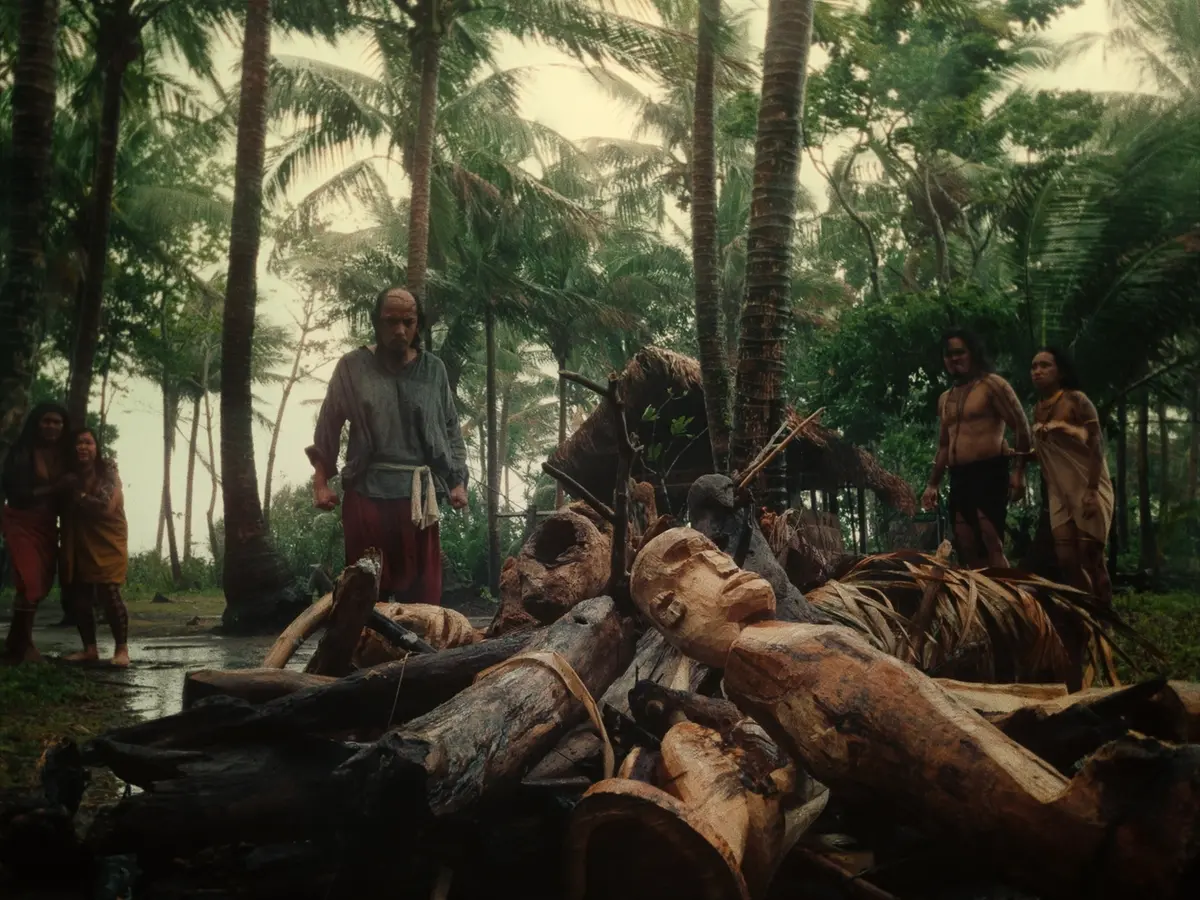
The man and his crew are a synecdoche of the West, its alleged humanism, its contradictions, its thirst for blood and power. The oppressor’s plague affects faith and language first (as in the case of Enrique, the enslaved interpreter), but Diaz’s cinema does not bend to its codes. The filmmaker’s images are dense ripples in the aesthetic and political narrative of History, fragments of an immensity (the film being an excerpt from an approximately nine-hour assembly) beneath which the invisible ghost of colonial violence always lurks.
Before ending, the film fixes its gaze on the slow death overtaking Magellan, surrounded by the remnants of the massacre –or rather, of its genesis. There is nothing left but to return to Enrique, who, aware of his own complicity in the gray zone between victim and perpetrator, sheds the clothes and culture of his master. And he looks ahead, a vicar of the silent guilt that binds all of us as spectators.