

Article by Marilina Rita Monzo
Translation by Anna Smaniotto
People say that being passionate about something means focusing on that activity day and night, dedicating yourself completely to it. But what happens to your dedication when this passion of yours comes from the need to satisfy social expectations? This is the question at the heart of Costanera – the debut film of director Mauro Díez Concari – which had its world premiere in the “Zibaldone” (Miscellaneous) section of the 44th Torino Film Festival. It is a musical set between Italy and Argentina, which tells – to the rhythm of jazz – the story of a man who plays for others, losing touch with himself in the process.
At the heart of the film there is a journey from Rome to Buenos Aires -a metaphorical passage marked more by disorientation than by growth. The protagonist is Diego (Michele Sallicandro), a young trumpet player who tries everything to finally feel the music he can only sense coming from outside, from different places and people, but never within himself. His words “I want to feel sad after a jam session” become a mantra but only cause him to sink deeper. To visually convey this fracture, the director makes a counterintuitive choice: while the shots of the outside world are an explosion of colour, the musical moments – where we would expect the exact opposite – are in black and white.
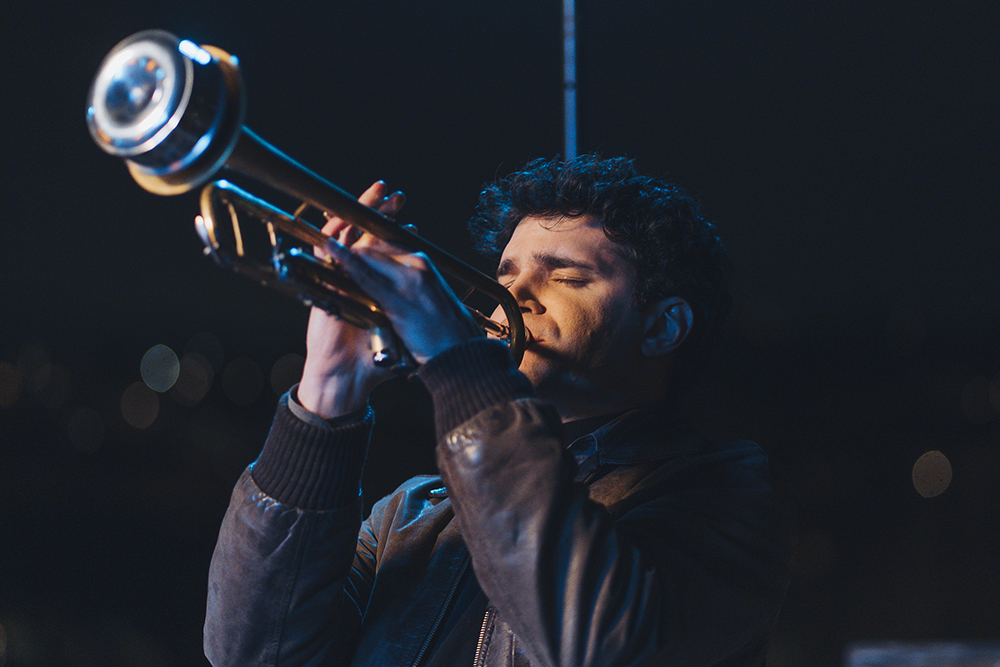
Camila (Celeste Dalla Porta) serves as a counterpoint to all this, laying Diego’s crisis bare even further. She is a young woman living in Buenos Aires, with her sights set on Europe. Camila is ready to pursue a career in translation, following a dream with almost selfish determination, since she wants to make it on her own. The contrast between her clarity and Diego’s chaos gives the film its spark, prompting the characters to express through their bodies what they cannot put into words. Through an interplay of singing and dancing, the two gradually grow closer, eventually falling deeply in love. The camera stays close to their bodies, lingering on their faces and turning every musical number into a sudden confession.
The death of Diego’s father marks the lowest point of his descent and the void created by his loss allows Diego to finally hear the music coming from within. No longer needing to please an outside observer, music ceases to be a mere exercise in style and becomes a real necessity instead. The musical takes on a more intimate form, confronting disorientation without any filters. Costanera reminds us that, sometimes, it is when we have nothing left to cling to that we are finally able to hear our own voice.