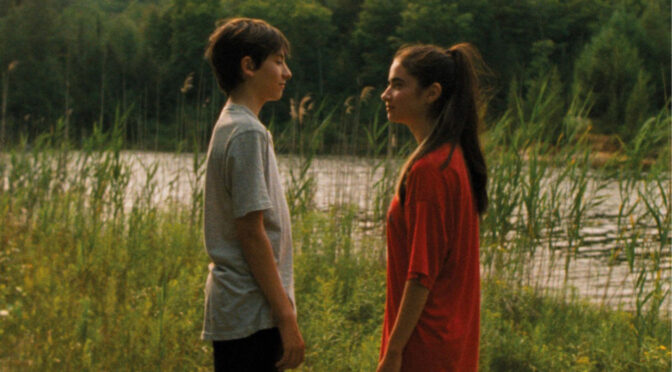
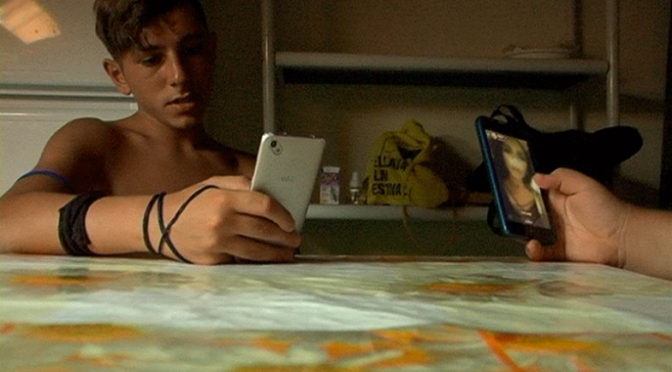
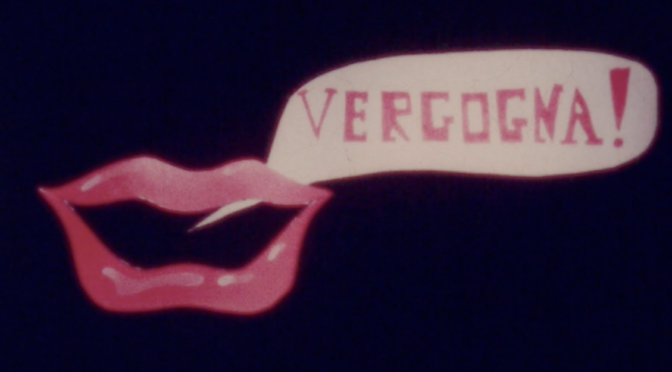
Sono sulla riva del loro lago, quando Chloé (Sara Montpetit) chiede a Bastien (Joseph Engel) quale sia la sua più grande paura: il ragazzo sorride, scrolla le spalle e risponde che è masturbarsi di fronte a mamma e papà. Quando Chloé si confessa a sua volta, sta piangendo: «Credo che la mia più grande paura sia di sentirmi sola tutta la vita».
Charlotte Le Bon, al suo esordio alla regia, scandaglia l’adolescenza mostrandola durante una parentesi estiva al lago. Per farlo, attinge a piene mani dalla graphic novel Una sorella (Bao Publishing, 2018) del francese Bastien Vivès, in cui vengono trattate le ambivalenze del desiderio giovanile al suo nascere. Falcon Lake si concentra sull’attrazione reciproca tra i due protagonisti. Lei, Chloé, è una sedicenne che si sforza di comportarsi da adulta anche quando vorrebbe solo darsi il tempo di cui ha bisogno. È forse proprio questo che la spinge a ricercare Bastien, di due anni più giovane di lei, apertamente inesperto e soggiogato dal fascino della ostentata e costruita sicurezza di lei. I due ragazzi sono immortalati nella loro più pura ingenuità, mentre scoprono, impacciati, uno il corpo dell’altra. Sullo sfondo del loro rapporto ci sono gli adulti veri e propri, i genitori. In Una sorella, Vivès non disegna mai i volti, perché quella non è la loro storia. Le Bon ripropone questa scelta nel suo linguaggio, quello cinematografico: i genitori sono relegati fuori campo, i visi non si vedono e rimangono soltanto le voci.
Nel finale, Le Bon, anche autrice della sceneggiatura, si discosta dall’opera su cui è basato il suo lungometraggio. La conclusione che ha scelto per il protagonista maschile è l’emblema dell’adolescenza in sé, rappresentata come un periodo della vita al confine tra la vita e la morte. «Ci sono fantasmi che non sanno di essere morti» e sono questi fantasmi, con i loro desideri, a popolare la giovinezza. I protagonisti vivono le loro esperienze in maniera assoluta e fatalista, senza l’elaborazione emotiva tipica di chi l’adolescenza l’ha già superata e ne è uscito indenne.
Falcon Lake non si allontana molto dai cliché narrativi del coming of age. Nonostante questo limite, la regista crea uno spazio di rigorosa rappresentazione in cui si alternano inquietudini e scoperte dell’adolescenza, dentro le quali lo spettatore può ritrovare se stesso e il proprio vissuto.
With the presentation to the press of the Casa Torino Film Festival, the run-up to TFF40 came to an end. It will begin (screenings, events, masterclasses) on November 25th with the opening ceremony at the Teatro Regio in Turin, for the first time also broadcast live on radio as part of Hollywood Party on Rai Radio3, dedicated to «a tale through music and images on the relationship between the Beatles, the Rolling Stones and cinema».
Last week, the opening press conference of the event took place at the Cinema Quattro Fontane in Rome, celebrating the important milestone of its fortieth edition, coinciding with the long-awaited emergence from the devastating pandemic nightmare.
The promoters unveiled an ambitious, varied and richly innovative program, both in terms of the films on offer and the spaces for interaction between artists and the public, laying the foundations for an edition full of expectations.
In terms of logistics, the first novelty is the Casa Torino Film Festival, which will be located in the Cavallerizza Reale, also the festival’s Media Centre, thanks to the collaboration with our University. The centre aims to become «the nerve centre of the festival where most of the meetings and events will take place», as the new artistic director Steve Della Casa presented it (in fact a veteran already at the helm of the TFF between 1999 and 2002, and one of its founders in 1982 under the impetus of Gianni Rondolino and Ansano Giannarelli). Moreover, as summarised by the president of the National Museum of Cinema in Turin, the TFF’s promoting body, Enzo Ghigo, the entire city will be involved through a «look of the city that will go beyond the usual festival spaces to dress up the squares and streets of Turin with real works of art, created by the brilliant graphic trait of Ugo Nespolo, who also signed the guiding image». A sort of urban mapping that has long been in vogue in large metropolises and is likely to appeal to visitors of all ages.
Many guests will arrive in Turin during the festival, well-known faces from show business, music, cinema and beyond. The legendary protagonist of A Clockwork Orange, Malcolm McDowell (who will receive the Star of the Mole, will be honoured with a retrospective and will hold a masterclass), Paola Cortellesi, Toni Servillo, Mario Martone, Paolo Sorrentino, but also Vittorio Sgarbi, the singer Noemi, the producer Marina Cicogna, Michele Placido, Sergio Castellitto, the former goal twins Vialli and Mancini, Simona Ventura and many others will be among the guests.
As far as the program is concerned, in addition to a competition of national and international previews divided into the feature, documentary and short film sections, a rich out-of-competition section stands out (for a total of 173 works, 81 of which are world premieres) ranging from the solo show of the young Spanish director Carlos Vermut to the Portraits and Landscapes category, from the more “committed” section (Of Conflicts and Ideas) to the New Worlds of Auteur, up to Crazies, an anthology of films on what is new in horror production worldwide, destined to send the multitude of fans of the genre into raptures.
Malcolm McDowell
Not forgetting Back to life (the restored films), High Noon (the misunderstood classic American westerns), the homage to documentary filmmaker/collector Mike Kaplan, and the unfailing Masterclasses, what stands out is the strongly heterogeneous character of a program aimed at highlighting first works as well as average genre cinema (plus the so-called B-series production but with cult-movie potential), trying to be «a festival that remembers the past but thinks of the future, a festival that is cultured but popular, research but fun. A festival that wants to be a party».
With a keen eye on contemporary issues such as environmental sustainability, gender violence, which will also be remembered by the event’s patroness Pilar Fogliati with the anniversary of the International Day for the Elimination of Violence against Women, the many guests who will meet the public «telling their ideas and their point of view» and the varied schedule, the director emphasizes the festival’s desire to combine high and low culture, aiming to involve professionals from the sector, the event’s loyal audience and those who, intrigued by the novelties, will be able to approach the event.
Con la presentazione alla stampa della Casa Torino Film Festival si è conclusa la fase di avvicinamento al TFF40 che aprirà (proiezioni, eventi, masterclass) il 25 novembre con la cerimonia di apertura al Teatro Regio di Torino, per la prima volta anche in diretta radiofonica all’interno di Hollywood Party su Rai Radio3, dedicata a “un racconto per musica e immagini sul rapporto tra i Beatles, i Rolling Stones e il cinema”.
The boat trip of a father with his two daughters will soon become a nightmare. This is the simple premise on which is built Inmersión, the debut feature film of Chilean director Nicolás Postiglione that investigates what’s underneath its characters. «It’s a shame that no one comes here anymore» comments the father, while observing with nostalgia the places where he grew up, now apparently deserted. And yet, the unstable balance of the three protagonists is definitely destroyed by the encounter with some castaways who, after being welcomed aboard, start to make the father seriously fear for his and his daughters’ lives.
Il riconoscimento intitolato a Maria Adriana Prolo, fondatrice del Museo Nazionale del Cinema, quest’anno è stato assegnato a Giuseppe Piccioni. Un premio alla carriera, alla memoria dei suoi film, alle battaglie silenziose che questi hanno saputo raccontare.
Over the last two years, Torino Film Festival has given new life to the short film category by bringing them back in the official competition in the last edition. This year, they were at the centre of an interesting novelty: each of the twelve films selected by Daniele De Cicco has accompanied one of the feature films in competition before their respective screenings during the days of the festival. A signal of recognition and respect towards an increasingly popular practice in Italy, which has its core in the Turinese festival.
“LIBERTY” BY JOHANNA RÓŻNIAK
A group of youngsters fight for their ideals: an unacceptable action to the society which dominates the dystopian future in which the Polish director’s short film takes place.
Kuba, a young member of the opposition group, gets arrested and finds himself inside a super high-tech prison from which he could never escape, were it not for the help of his father, an important politician. The increasingly stringent limitations imposed on young people, the abuse of power by law enforcement, the technology able to violate any semblance of privacy, the recommendation: all these current themes are analysed perfectly over 14 minutes of terrifying reality.
“NIGHT” BY AHMAD SALEH
Starry and deadly night, a merciful goddess who, like a mother, puts to sleep her children, exhausted by the bombs, by the dust and by the unrelenting pain. A woman rebels against the sweet lullaby, lets out a desperate cry, an appeal of hope to find her young daughter, lifeless, buried under the rubble: what can the Night do but bring peace to her soul, as well? Palestinian director Ahmad Saleh, in this grueling short film, talks about the infamy of war, which forces men to accept their departure peacefully, as the only solution to rid themselves of the constant threat of the shootings and violence.
“LA ÚLTIMA PIEZA DEL PUZZLE” BY RICARDO MUÑOZ
Freedom, continuously evoked by the words on the poster: “PUEBLO SATISFECHO, PUEBLO LIBRE” (“satisfied People, free People”), and its denial, which can be caused by something as simple as reacting to law enforcement authorities, are at the core of the short film by the Venezuelan director. By narrating the simple story of citizen Albertini, who is always missing one piece to complete his puzzles, Ricardo Muñoz lets out a cry of rebellion against the main totalitarian regimes which have dominated numerous countries and continue to do so.
“MAVKA” BY ANASTASIA LEDKOVA
The short film by Anastasia Ledkova is an exquisite, dream-like look at a family tragedy. The death of a woman might be the right time for her son and husband to start a new life. The two of them have different views on the idea of moving, but all that is overshadowed when the son finds a sweet and mysterious girl, concussed, on the bank of a river. The unknown girl wins over the two protagonists with her elegance and innocence, behind which hides a terrible truth that will hit them both hard.
“BACKYARD CAMPING” BY MOR HANAY
A peaceful and pleasant night under the stars seems to be the best way to resolve, although temporarily, the numerous family problems that the protagonist couple have and are aware of. The backyard is the setting, the camping tent becomes a fortress, but the desired resolution never comes, because of a surreal thief and an unbeatable tree.
“RENDEZ-VOUS” BY ROSHANAK AJAMIAN
Baran and Navid are a young Iranian couple going through a crisis. Baran intends to end the relationship as she is in love with her husband’s sister. The shock is painful, especially considering that they have recently moved to Canada, and Navid could have never predicted the end of the relationship. The director chooses to alternate between the two on a date and fragments of Baran crying desperately in the car, aware of the suffering that is about to come.
“LA CATTIVA NOVELLA” BY FULVIO RISULEO
This animated short by Fulvio Risuleo offers an elaborate meditation on the relationship with death, religion, and the future of human relationships in the new world that is moving forward.
The film is divided into three acts, each accompanied by three songs by singer-songwriter Mirko Mancini (aka Mirkoeilcane, ed.). Although the musician’s voice is fundamental to hold the metaphorical reflection together, the metaphysical content which accompanies the descent of Jesus on Earth is completely overshadowed by the visual plotline featured in the film’s mise-en-scène. The three tones corresponding to the different acts of the short film are extremely effective: the first act, dedicated to the Black Angel, is white and cold; the second act, containing the preparation for the descent, is black and gloomy; the last act, which chronicles the old Giovanni’s funeral, is colourful and warm.
“JUNKO” BY MINSHO LIMBU
The story of Junko is the story of many Nepalese new brides, forced to live far away from their husbands who leave for India looking for a job.
Minsho Limbu decides to chronicle, with echoes of Beckett, the young woman’s wait for her Godot, who may never return home.
The directing is elegant and subtle, the camera lingers on Junko’s microcosm, accompanying her in the realisation of her future solitude, as it was for her mother and for the women of previous generations. Limbu studies every shot in detail, as the production design remains essential and functional to what is being told; in this way, the story almost seems to tell itself in front of the lens. The film is an example of great storytelling, it leaves no questions unanswered and chronicles, without pity and sentimentalism, a cross-section of the cultural life in Nepal.
“NEON MEETS ARGON” BY JAMES DOHERTY
The whole problem of life, then, is this: how to break out of one’s own loneliness, how to communicate with others. Cesare Pavese, This Business of Living: Diaries.
Immersed in a blaze of colours, an Hephaestus with an Irish accent accepts a young apprentice into his peculiar neon sign factory. Alienated by the community and unfamiliar with social relations because of his prolonged isolation, the old craftsman’s neon light turns on thanks to the arrival of a friendly individual who bursts into his dull daily routine. The two lost souls struggle to communicate, but the barriers are broken down by the need of finding themselves through one another.
“BABATOURA” BY GUILLAUME COLLIN
Making the most of a frantic style of directing which chases after the characters’ dialogues through fast-paced, back-and-forth exchanges, the short film by Guillaume Collin describes the delicate balance of a Canadian family, gathered for dinner.
Many secrets and fears grip the heart of Benoit, worried that his family will not accept the illegitimate son which his partner carries in her womb. The mise-en-scene helps to understand the nature of each of the diners seated around the table, and simultaneously displays their reaction to the shocking news that destroys the principles of a traditional family, thus measuring the extent of their love for one another.
“LA NOTTE BRUCIA” BY ANGELICA GALLO
Riding the (overlong) wave of crime stories set in the outskirts of Rome, a theme and a leitmotif which have oversaturated Italian cinema in the last few years, director Angelica Gallo condemns an environment in which teenagers find no way to emerge as individuals and as members of society, other than associating themselves with criminals. The presence of Marcello Fonte e Aniello Arena enriches a genre short film which depicts teenagers living on the street like stray dogs, working in packs to survive, but ready to betray one another in the name of a god who knows no morals: money.
“AIN’T NO MERCY FOR RABBITS” DI ALIZA BRUGGER
Director Aliza Brugger presents in competition an all-female western film that revolutionises the genre as it has traditionally been imagined, by reinventing the woman’s role: no more a defenseless creature, incapable of providing for herself in an arid and treacherous environment, like that of the desert. Indeed, the small Ronan lives with her ailing grandmother in a hostile environment, far away from any kind of civilization and from natural resources. They are surrounded by a rocky horizon, but no cowboy comes galloping to their rescue. “You gonna be the wolf or the rabbit?”: this is the question that runs through the mind of the young protagonist who, inspired by her grandmother’s teachings, fights against the fear of not being able to survive. Knowing that she can only rely on her abilities, the young Ronan learns to ride, a symbol of independence and freedom.
In 1977 in China, a few months after the fall of Mao Tse-tung and the subsequent reassembly of the Communist Party of China, a valley not far from the city-prefecture of Tangshan, in the province of Hebei, is submerged in order to create an artificial dam that can supply water to the nearby big city. Underwater, however, not only the houses and shops that have been cleared run out, but also an entire stretch of the Great Wall, the monument that more than any other, perhaps, characterizes China in the world. Forty years after the construction of the dam, some local inhabitants, noting the misery of the conditions of a part of the wall on the surrounding hills, decide to put on a restoration operation to give new prestige to the millenary monument.
Los plebes, the documentary presented in TFF’s “The rooms of Rol” section, dives into the intimacy of young millennial sicarios who roam Sinaloa, Mexico, at the service of drug traffickers, showing their passions and hopes for the future. And, by dwelling on these budding assassins’ use of social media to recount their double lives, the story tries to question the media and offers a profound reflection on death.
«Filming you with the camera is just an excuse to watch you», says Gainsbourg Birkin, with a sweet and quiet tone, during one of the first scenes of Jane Par Charlotte. The movie premiered at the 74th edition of Cannes Film Festival and was proposed again at the TFF39 in the “Surprise” section. It immediately crosses the cold boundaries of the biographic documentary, taking the form of an intimate and very lively conversation between mother and daughter. There lies the hiatus between these two identities which, like the hiatus between biography and autobiography, becomes more and more ephemeral, until it involves also Joe, Charlotte’s youngest daughter.
“Rol’s room”, a parallel section of TFF39 dedicated to genre cinema, opens with Coming home in the dark, which warns the viewer right from the start. The Hoaganraad family, on a trip to an isolated stretch of New Zealand coastline, comes across two mysterious vagrants and the doubt immediately arises: has this encounter been meticulously planned or is it nothing more than a cruel twist of fate?
Naples-based street art duo Cyop&Kaf are back in theatres with a new documentary, following their 2013 critically acclaimed The Secret (2013), which was presented during Torino Film Festival’s 31st edition. Their new film, Yeast, is the result of a twenty-year-old reflection. Using their camera to follow a summer camp, a theatre laboratory inside of a museum and a judo dojo, the two directors wonder about educational practices, starting from the level of the student-teacher relationship.
Julie Lecoustre and Emmanuel Marre present their first long feature film out of competition, a story that moves along a double track: the almost documentary-like representation of low-cost airline flight attendants and the main character’s introspective analysis, as she is unable to work through her grief.
Italia, il fuoco e la cenere is a poetic and oneiric journey through the divas, ghosts, lights, and shadows of Italian silent cinema. It explores its most material essence, it brings its lantern closer to the flesh, the bodies, the bare shoulders in the half-light, the penetrating gazes, the feverish convulsions of the divas. The erotic component is central: cinema made the prudes tremble, in the darkened rooms it allowed women and men to blend. The cinematic exploration becomes a historical exploration and paints the reality of a country in constant transformation, from the pompous and resplendent scenes to the decadence and abyss of fascism that are inexorably approaching.
La gita in barca di un padre insieme alle sue due figlie si trasformerà presto in un incubo. È questa la semplice premessa su cui si costruisce Inmersión, lungometraggio d’esordio del regista cileno Nicolás Postiglione che indaga ciò che c’è sotto la superficie dei suoi personaggi. «È un peccato non venga più nessuno qui» commenta il padre osservando con nostalgia i luoghi in cui è cresciuto, ora apparentemente disabitati. Eppure, l’equilibrio precario dei tre protagonisti è definitivamente sconvolto proprio dall’incontro con alcuni naufraghi che, accolti a bordo dell’imbarcazione, iniziano a destare nel padre il timore che le loro vite siano in serio pericolo.
Il Torino Film Festival nell’ultimo biennio ha dato nuova linfa alla categoria dei cortometraggi, rientrati in competizione ufficiale dalla scorsa edizione e quest’anno protagonisti di una interessante novità. Ognuno dei dodici film selezionati da Daniele De Cicco, infatti, ha accompagnato uno dei lungometraggi in concorso durante le rispettive proiezioni nei giorni del festival. Un segnale di attenzione e rispetto verso una pratica sempre più viva in Italia e che ritrova la sua centralità nella rassegna torinese.
“You must go on. I can’t go on. I’ll go on.” Samuel Beckett
In Potenza, during the night of the winter solstice – the longest night of the year – a woman is dissatisfied with her job, three boys are trying to escape adulthood, a corrupt politician is attempting to achieve some sort of salvation, and the heart of a young boy gets broken. These are the stories that Simone Aleandri’s film, out of competition at the Turin Film Festival, weaves together; stories of characters in crisis, unstable, different stories that converge, however, in the same place: a gas station, the place where the film begins.
Presentato in concorso al TFF39, il primo lungometraggio del regista turco Selman Nacar è un dramma etico e psicologico, che si concentra sul processo di cambiamento fissandone ogni suo più piccolo passaggio.
A Super 8mm amateur film, made in 1975, abandoned in the director’s basement for years, seriously damaged by the humidity coming from the lake near her house: this is the starting point of Undead Voices, the documentary by Maria Iorio and Raphaël Cuomo which aims to revive the feminist film Donne emergete! by Isabella Bruno. The story of Donne emergete! is shared by many films about militant feminism: «There was not enough interest in preserving them and they were considered unworthy» commented the curator and art historian Annamaria Licciardello, emphasising how this issue adds to that of the already limited number of feminists who have tried their hand at directing, in this historical period.
Multidisciplinary artist Amalia Ulman debuted in competition at TTF 39 with her first feature film “El planeta”, already presented at the 2021 Sundance Festival. The micro-budget and a small crew of five make this debut an experiment that evokes the independent American cinema of the 1990s.
An Abbreviated Manual to Free Cinema from Reality – Avi Mograbi’s Documentarist Forays, the title of Israeli director’s masterclass, is fairly self-explanatory. It closely mirrors the title of his film, The First 54 Years – An Abbreviated Manual for Military Occupation, which has been presented in the TFFDoc / non-competing section, and it mirrors its approach as well.
In both cases the director starts from specific images – the full-length features Z32 (2008) and The First 54 Years in the case of the masterclass and the archive of interviews belonging to the Breaking the Silence association in the case of the film – to be able to push for deeper thoughts in the respective fields, in this case military strategy and documentary films.
Thanks to this empiric process The First 54 Years allows the director to create a manual on military occupation techniques through the observation of multiple testimonies.
In very much the same way the director has used his two films as indisputable examples during the masterclass to show off the various possibilities of reality cinema. Although the two documentaries are based on the same source material, they go in different directions leading to two very different results. Z32 is entirely based on a war veteran’s ponderings about the actions he has committed throughout his military service. The First 54 Years, on the other hand, refuses any possibility of elaborating trauma, focusing instead on witnesses’ tales which expose facts and mechanisms regarding the Israeli occupation. As previously mentioned, the source material for both documentaries is made up of soldiers’ testimonies which have been collected by Breaking the Silence, an association founded by Mograbi himself with the aim of telling the story and the brutality of the Israeli occupation of Palestine and to keep alive those memories which governments from 1967 onwards have attempted to erase.
Z32 was created with the idea of making a fairly straightforward film telling the story of a soldier who regrets having taken part in a retaliatory action against Palestinian policemen. The possibility of making a movie centered around the emotions and thoughts of the soldier is hampered by the fact that the man does not want his face to be shown. This was solved thanks to the director’s intuition to cover the soldier’s face with a 3D digital mask which still left his eyes and mouth visible, thus enabling him to show his emotions. This solution notwithstanding, the veteran still found it hard to express himself freely. Mograbi then decided to give the soldier a camera, to allow him to autonomously reflect upon his actions. At this time the man’s girlfriend becomes a relevant figure, given that she takes part in the soldier’s ponderings and opposing his attempts to absolve himself. At the same time, the director is questioning the moral dilemmas surrounding his film: is it fair to hide a murderer inside one’s work? It is fair to exploit his story? These thoughts are told by the director via songs, almost as if the musical were a mask used to filter his reflections, similarly to what happens to the protagonist.
The First 54 Years moves in a different direction. In this case Mograbi uses a number of testimonies from Breaking the Silence’s archives, in order to make a film made up of a series of interviews. Mograbi focuses here on tales of actions, procedures, orders and mechanisms of Israeli military operations in Palestina, leading the viewer like a military tactics expert. The director, like a modern Machiavelli, recites passages of an imaginary military occupation manual which uses the Israeli case – from the 1967 West Bank occupation to the first and second Intifadas – as an examples to prove its points. These are harsh words which contrast strongly with Mograbi as a person, in a powerful attack towards the Israeli state confirming, once again, the director’s ability to question reality, internalize it and decline it in different ways – ironically, cinically, experimentally – which are always functional to a critical analysis of the world.
Il magazine delle studentesse e degli studenti del Dams/Cam di Torino
Utilizziamo i cookie per essere sicuri che tu possa avere la migliore esperienza sul nostro sito. Se continui ad utilizzare questo sito noi assumiamo che tu ne sia felice.